

Henderson County calls for closer look at Texas data centers
Courtesy Photo/Henderson County Admin YouTube
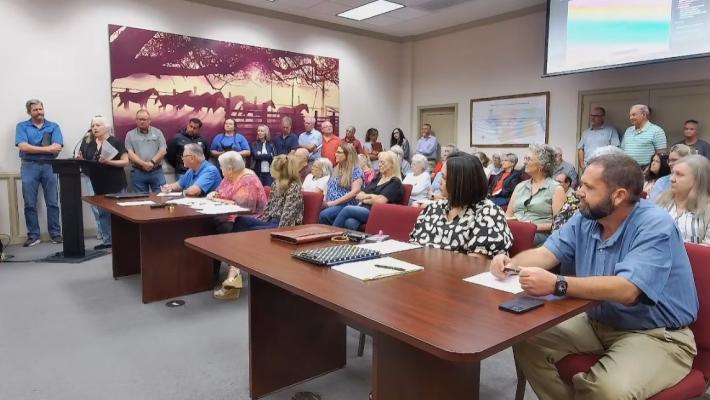
Speakers expressed their concerns and outright opposition to data center construction in Henderson County during the May 12 commissioners’ court meeting, fearing quality of life changes and stretching resources. The court adopted a resolution that day calling for tighter regulations and more scrutiny of the large-scale construction of facilities such as data centers, as well as urging the state legislature top give its political subdivisions of counties and cities more control over them.
ATHENS-May 12, Henderson County Commissioners’ Court adopted a resolution opposing data centers in the state of Texas, but beforehand, a litany of speakers expressed their disapproval of any data center that might change the county’s quality of life, especially around Cedar Creek Lake.
The resolution itself states the commissioners’ court opposes any future data center within the state of Texas that doesn’t employ “adequate safeguards to protect the county’s resources and residents.” During the May 12 discussion over the matter, county officials also referenced being approached about signing non-disclosure agreements.
Speakers made their points for more than an hour, led off by Ashley Cook, who told the court she is from Trinidad. Cook said that around Cedar Creek Lake, land value depends on the water, and that a data center that makes heavy use of public utilities such as power and water “could permanently change” the lake area’s character by lowering water levels.
“People bought property here because of the water, the views, the recreation, the serenity and the promise this would remain a lake community, not an industrial utility zone,” Cook commented.
Following the residents’ testimonies, County Judge Wade McKinney stressed “the state of Texas” when referring to the resolution’s scope, then handed off the agenda item to Precinct 1 Commissioner Wendy Spivey, stating the issue is “highly impactful to your (Spivey’s) area in bringing this action forward, so I will give you the floor.”
Spivey beckoned County Attorney Kenneth Strawn to come before the court. Strawn read the resolution, which notes the “the pace of data center construction has exponentially increased” around the nation, noting the mass of computers at data centers power technological advances such as artificial intelligence and cryptocurrency.
Strawn, continuing to read from the resolution, recited that without “reliable safeguards” Texas “could face substantial shortfalls in electricity generation and grid reliability over the coming decade, increasing the risk of service interruptions and higher energy costs for residential, agricultural and commercial consumers.”
The resolution also pointed out that area’s “recurring drought conditions” and that “certain” data centers can put strain on water availability. The Henderson County resolution also calls for “transparent” reporting of a planned data center’s utility usage and expresses fear of public roads and public safety being threatened, all while noting the county has little power to regulate them.
The resolution calls for a special session of the Texas Legislature to address the issue, as well as to pass legislation giving municipalities and counties meaningful participation and authority in land use, infrastructure planning and resource impact reviews relating to data center developments. The resolution will be sent to Gov. Greg Abbott, state representatives Keith Bell, Cody Harris, as well as the Public Utilities Commission of Texas (PUC), the Electric Reliability Council of Texas (ERCOT) and a host of other agencies and officials.
Precinct 3 Commissioner Chuck McHam told the standing-room only crowd that “we live here too” and that county officials also are concerned, but “we have very little control over these private property rights,” and in Texas, McHam continued, “that’s muddling around in deep water.” McHam said many data centers have been developed on “prime farm property” that was taken by the government.
McHam made more observations. “I know it’s not about money, it’s about quality of life, But these companies have unlimited amounts of money.” He referred to the City of Sulphur Springs, which he said filed a lawsuit against a local data center’s construction, costing “millions” in legal fees.
“It’s not going to take y’all blaming us, it’s going to take y’all helping us,” McHam pleaded. “We’ve got to work together.”
Precinct 2 Commissioner Scott Tuley remarked that the state of Texas “does not like local control,” which he said has been eroded by the legislature in recent sessions. “In Precinct 2, no NDAs will be signed,” Tuley declared, adding he would continue that stance if the issue came for county consideration.
Strawn remarked that the county believes that non-disclosure agreements run counter to public transparency. “We’ve told this court, ‘Do not sign NDAs, we believe they violate the law’,” said Strawn.
Spivey made the motion to approve the resolution, which referred to “large-scale industrial development, including data centers” in its verbiage.